
Nationwide special-education counsel · Parents and students only
Special Education Lawyers for Parents Who Need a Plan—and a Record.
When an IEP, 504 plan, evaluation, placement, discipline decision, or failure to provide services becomes serious, the next meeting is not the only thing that matters. The record you build now may shape every option that follows.
- IEP & 504 disputes
- Evaluations & placement
- Due process & appeals
Have a meeting, hearing, discipline, or appeal date? Put the exact deadline at the top of your intake. Contacting a lawyer does not pause it.
 Attorney strategy
 Educational advocacy





Start with the decision—not the label
What is the school refusing, delaying, changing, or failing to do?
A strong special-education strategy usually begins with the exact decision, the document that records it, and the remedy the family needs.
Evaluate or find eligibility
Initial evaluation, reevaluation, suspected disability, Child Find, independent educational evaluation.
Build the evaluation record → 02Write or implement the IEP
Missing services, weak goals, inadequate progress, related services, supports, compensatory education.
Examine services and progress → 03Provide an appropriate placement
Least restrictive environment, private placement, tuition reimbursement, school refusal, placement changes.
Understand placement strategy → 04Protect a disciplined student
Suspension, removal, manifestation determination, behavior plans, interim placement, expulsion.
Protect disability rights → 05Provide 504 accommodations
Access, accommodations, health and safety plans, disability discrimination, retaliation.
Connect the 504 issues → 06Respond to bullying or danger
Disability harassment, school refusal, unsafe transportation, restraint, seclusion, serious incidents.
Preserve the safety record →The legal framework
The right strategy depends on the school, the law, and the remedy.
IDEA, Section 504, the ADA, state law, and school policies can overlap—but they do not create identical rights in every setting.
FAPE is delivered through an IEP built for the individual student.
IDEA includes procedural safeguards and dispute-resolution routes such as state complaints, mediation, and due process. The question is not simply whether the school held a meeting; it is whether the evaluation, program, placement, services, implementation, and progress can be defended on the record.
IDEA information for parents and families ↗Disability access can matter even when a student does not have an IEP.
Section 504 prohibits disability discrimination by covered recipients of federal financial assistance. Evaluations, accommodations, equal access, discipline, harassment, retaliation, and implementation may require analysis apart from—or alongside—IDEA.
U.S. Department of Education disability guidance ↗Parentally placed private-school students do not automatically have the same individual IDEA entitlement.
A child placed in private school by a parent generally does not have an individual right under IDEA to receive the same services the child would receive if enrolled in public school. Tuition reimbursement can be available in some disputes when a public agency failed to make FAPE available and the private placement was appropriate, but notice and other rules can affect relief.
Read the federal private-school rule ↗When legal help changes the trajectory
Do not wait for a final “no” if the record is already moving against the student.
Not every IEP disagreement needs a lawyer. Legal strategy becomes more valuable when the dispute is consequential, recurring, document-heavy, deadline-driven, or likely to affect placement, services, discipline, safety, graduation, or reimbursement.
- 01
Before a pivotal meeting
The district is proposing or refusing evaluation, eligibility, placement, services, or a major reduction in support.
- 02
After written notice or a pattern of delay
The school’s position has hardened, promised action never happens, or the documents do not match what the family was told.
- 03
When discipline changes placement
A removal may trigger disability-related protections, including a manifestation determination on the federal timeline.
- 04
Before choosing a formal remedy
Negotiation, complaint, mediation, due process, reimbursement, or litigation should be selected for the actual objective—not simply because it exists.
Choose the right kind of help
Do you need legal strategy—or hands-on educational advocacy?
Both services begin with the student’s records, but they do different jobs. Choose based on the decision in front of the family, not simply the lower price.
Attorney legal strategy · $600
Choose LISS when the legal record or remedy matters.
A Legal Information and Strategy Session includes focused attorney record review, a private strategy meeting, and a written legal action plan.
- A meeting, response, discipline, hearing, or appeal deadline
- A consequential refusal involving evaluation, services, placement, or safety
- Due process, a complaint, reimbursement, settlement, or litigation may be considered
- The family needs legal advice about rights, risk, evidence, or available remedies
Mary-led educational advocacy · options from $475
Choose the RMR when the immediate need is understanding and improving the plan.
Review, Meet, Report is educational advocacy focused on the current IEP or 504 plan and practical recommendations for what to ask for next.
- The family wants an experienced educator’s review of the current program
- The next step is preparing for an IEP or 504 meeting
- The parent needs help identifying educational questions, priorities, and possible supports
- No formal legal opinion, legal advice, or attorney representation is being requested
Not sure? If there is a legal deadline, discipline, formal complaint, placement or tuition-reimbursement question, possible hearing, or request for legal advice, begin with LISS. The team can identify whether educational advocacy should also be part of the plan.
No names or facts collected
Find the right first step.
Serious injury, assault, sexual assault, hazing, or school-bus injury may qualify for direct screening. Discipline and defense strategy generally begins with LISS.
Which kind of school or college problem is closest?
Is there already a hearing, response, or appeal deadline?
A consultation does not pause a deadline.
Which statement is the strongest accurate match?
Do not enter names, medical details, or evidence here.
Start with a Legal Information and Strategy Session.
LISS is the paid strategy lane for discipline, defense, Title IX, IEP/504, academic integrity, private-school, college, and other matters that need attorney analysis and an action plan.
Put the deadline at the top of the LISS intake.
Preserve the notice and attachments, identify the exact date and time, and call 888-959-5529 if the deadline is immediate. Starting a LISS does not extend a school or college deadline.
Your answer shows a direct-review indicator.
Continue to screened contact intake. This route does not mean the firm will accept the matter and is not a conclusion about liability or damages.
A direct damages intake may not be the right first step.
School claims can involve immunity, notice, causation, and damages rules. LISS lets a lawyer evaluate the facts, deadlines, duties, and realistic options without promising a damages case.
This routing tool provides general information only. It is not legal advice, does not determine whether a claim exists, and does not create an attorney-client relationship.
The complete parent guide
Special-education disputes, issue by issue.
Open the part that matches the student’s current problem. Each section is designed to help a parent identify the evidence, decision, and next question.
Evaluations, eligibility, reevaluations, and independent educational evaluations
An evaluation dispute may concern whether the school recognized a suspected disability, assessed all relevant areas, used appropriate tools, considered parent and provider information, or correctly interpreted the results. Families should preserve referral requests, consent forms, evaluations, eligibility documents, report cards, progress data, medical or provider recommendations, and written notices.
When a parent disagrees with a public agency’s evaluation, IDEA regulations address independent educational evaluations at public expense and the agency’s response options. The wording and timing of the request matter, and an outside evaluation does not automatically dictate the IEP team’s conclusion.
IEP goals, services, implementation, progress, and compensatory education
An IEP is more than a list of minutes. The present levels, measurable goals, specially designed instruction, related services, accommodations, progress reporting, placement, and transition planning should work together. A dispute may arise because the plan is substantively weak, because services were never delivered, or because progress data shows the approach is not working.
Useful evidence can include service logs, provider schedules, progress reports, work samples, attendance records, communication logs, behavior data, assessments, and proof of regression or lost opportunity. Remedies depend on the facts and jurisdiction; missing services do not produce an automatic one-size-fits-all award.
Placement, least restrictive environment, private placement, and tuition reimbursement
Placement disputes are about the setting in which the IEP can be implemented—not merely the name of a school. The team may need to examine supports, peer access, class size, methodology, behavior needs, related services, and whether a proposed program can actually deliver the written plan.
Parents considering unilateral private placement should obtain advice before acting. Federal law includes notice requirements and permits courts or hearing officers to reduce or deny reimbursement in some circumstances. A private placement also must be appropriate; parental preference alone is not the legal test.
Suspension, manifestation determinations, behavior, and changes of placement
When discipline results in a qualifying change of placement, IDEA requires a manifestation determination within 10 school days of the decision. The team reviews whether the conduct had a direct and substantial relationship to the disability or resulted directly from the school’s failure to implement the IEP. Other rules govern services, interim alternative settings, appeals, and special circumstances.
Preserve the incident report, discipline notice, witness accounts, video requests, behavior plans, evaluations, IEP, service records, prior incidents, and all communications. If police or child-protection agencies are involved, statements in one process can affect another.
Section 504 plans, accommodations, discrimination, and retaliation
Section 504 may protect students whose disability substantially limits a major life activity, including students who do not qualify under IDEA. Disputes may involve evaluation, accommodations, health plans, attendance, testing, discipline, extracurricular access, disability harassment, inaccessible policies, or retaliation for protected advocacy.
A useful record connects the student’s limitation to the requested access and shows what the school knew, what was requested, what it decided, and what happened after the decision.
Bullying, restraint, seclusion, transportation, school refusal, and safety
Bullying or unsafe conditions can interfere with access to education and may require the IEP or 504 team to respond. The legal analysis can involve special-education duties, disability discrimination, supervision, transportation, state rules, and—in serious injury or assault matters—separate liability and notice requirements.
Document dates, reports, witnesses, injuries, treatment, attendance changes, regression, transportation records, prior warnings, and the school’s response. Serious injury, employee assault, sexual assault, hazing, or a school-bus crash may qualify for screened direct intake rather than requiring LISS first.
Transition planning, graduation, diplomas, and life after school
Transition planning should be individualized and connected to postsecondary education, employment, and independent living where appropriate. Families may need to examine assessments, measurable postsecondary goals, courses of study, agency connections, community-based instruction, vocational support, graduation pathways, and whether services end before the student is prepared.
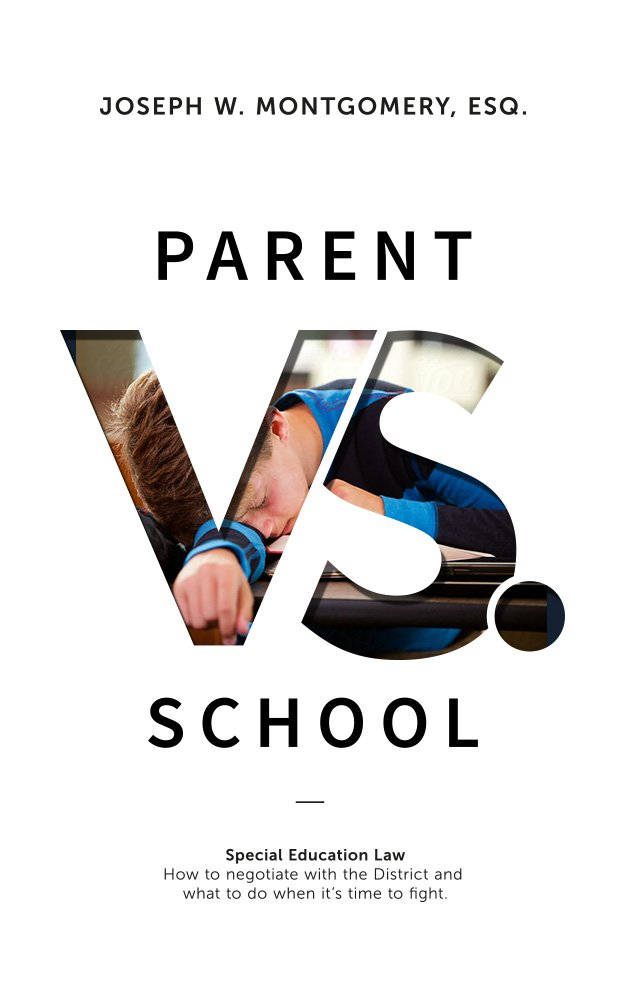
Written for parents who need leverage
Parent vs. School
Joe Montgomery’s practical guide explains how to negotiate with a school district, prepare the record, and recognize when it is time to fight.
Get the book on Amazon →Questions parents ask first
Special education lawyer FAQ.
General information only. The right answer depends on the student, record, jurisdiction, deadline, and remedy.
Do I need a lawyer for every IEP meeting?
No. Many families participate effectively without counsel. A lawyer may add value when the school has taken a consequential position, the dispute keeps repeating, the family is considering a formal remedy, placement or safety is at stake, or the record needs to be built with a hearing or appeal in mind.
What can I do if the school refuses an evaluation or service?
Ask the school to put its decision and reasons in writing, preserve the request and response, and review the procedural safeguards. The available next steps can include another team meeting, written advocacy, mediation, a state complaint, due process, or another route depending on the issue and jurisdiction.
Can a district be required to pay for private school?
Sometimes, but not merely because a parent prefers private school. Reimbursement disputes generally require analysis of whether the public agency made FAPE available, whether the private placement was appropriate, and whether notice or equitable considerations affect relief. Obtain advice before unilateral placement when possible.
What is a manifestation determination?
When a public-school discipline decision would produce a qualifying change of placement, the relevant members of the IEP team must determine whether the conduct was caused by, or had a direct and substantial relationship to, the disability, or directly resulted from a failure to implement the IEP. Federal law sets a 10-school-day timeline after the change-of-placement decision.
Does IDEA apply the same way at private schools?
No. Parentally placed private-school students generally do not have an individual IDEA entitlement to the same services they would receive in public school. Different rules can apply to child find, equitable services, public placements, unilateral placement, reimbursement, Section 504, and contractual rights.
What is a LISS?
A Legal Information and Strategy Session is a focused, limited-scope service that includes attorney record review, a private strategy meeting, and a written action plan. It is not ongoing representation, and its $600 fee is not credited toward a later advance fee.
Do you take serious school injury or assault cases without LISS?
Potentially. Serious injury, employee assault, sexual assault, hazing, or a school-bus crash may qualify for screened direct review depending on the facts. Use the case screener above. A direct-review indicator does not mean the firm will accept the case.
The next meeting is part of the record
Build the plan before the school builds the final answer.
Start with focused attorney review and a written action plan—or use the screener if the matter involves a serious injury, assault, hazing, or school-bus incident.
Past results do not guarantee a similar outcome. Representation begins only through a written agreement.